
We may earn a commission if you buy through our links, at no extra cost to you.
For dry-climate riding, choose a sealant you will check often enough to keep liquid in the tire. A bottle promising bigger puncture repairs is less useful if the sealant has dried out before the next ride. Start with the installation method and maintenance instructions, then check compatibility with your tire, rim and any insert.
Orange Seal positions Endurance for longer intervals between top-offs.[2] Stan’s Race Day asks for much more frequent inspections; Caffélatex offers a synthetic-polymer formula with its own dosing guidance.[1][3] SILCA’s current Ultimate Tubeless Tire Sealant adds a valve-injectable option that uses the same sealant for top-ups rather than a separate replenisher.[4] Choose by the maintenance routine and compatibility your setup needs.
Quick comparison
| Sealant | Reason to consider it | Verified maintenance or installation detail | Main tradeoff |
|---|---|---|---|
| Orange Seal Endurance | Prioritizing time between top-offs | Manufacturer positions it for longevity; 4 oz and 8 oz injector bottles include a dipstick.[2] | Longer-life positioning is not a guaranteed dry-climate interval. |
| Stan’s Race Day Tubeless Sealant | Event preparation with regular tire checks | Visually inspect every 2–3 weeks; pour directly into the tire, not through a valve.[1] | Frequent checks and bead access make it a poor fit for set-and-forget maintenance. |
| Effetto Mariposa Caffélatex | A synthetic-polymer formula with valve injection | Manufacturer recommends checking liquid every two months; bottles include an injection tube.[3] | Dose varies by tire; holding air does not prove active puncture protection. |
| SILCA Ultimate Tubeless Tire Sealant (current injectable formula) | Valve injection and same-product top-ups | SILCA advises reinstalling every six months and topping up after sealant loss; no separate replenisher.[4] | Not compatible with Reserve Fillmore valves; do not mix with the older formula or replenisher.[4] |
Orange Seal Endurance: for riders prioritizing top-off intervals
Orange Seal describes Endurance as formulated to maximize longevity. Its injector version is intended for adding sealant through the valve, and the 4 oz and 8 oz injector bottles include a dipstick.[2] That makes it worth considering if you want a way to check the liquid level without treating every inspection as a full tire teardown.
The reason to choose it is the maintenance approach, not a promise that it will outlast every other sealant in Colorado. Your first few checks should tell you more about your own setup than a broad claim about months between refills.
Choose the injector package if you need those installation accessories; do not assume a refill bottle includes them. Follow the bottle’s current instructions and check the valve arrangement before opening the sealant. The manufacturer’s linked product information is the place to confirm the recommended amount for your tire.[2]
View Orange Seal Endurance details · Check price at Jenson USA. Check the exact version and size before buying.
Stan’s Race Day: an event-focused option with extra upkeep
The current product is Stan’s Race Day Tubeless Sealant. Stan’s says it uses more sealing crystals than its Original formula, including larger crystals, and recommends visual liquid checks every 2–3 weeks.[1] That inspection schedule should be part of the purchase decision, not a footnote discovered after installation.
Race Day must be poured directly into the tire over the bead. Stan’s explicitly rules out valve installation and injectors.[1] If you want to top up solely through a removable valve core, choose a formula whose instructions permit it rather than trying to force Race Day through.
It is a reasonable shortlist option for someone willing to open the tire and inspect it regularly before an event. It is not our default recommendation for a bike that sits untouched between occasional rides.
View current Stan’s Race Day details · Check price at Jenson USA. Check the exact version and size before buying.
Caffélatex: synthetic polymers and a different dosing plan
Effetto Mariposa describes Caffélatex as a blend of liquid synthetic polymers that foams when the wheel moves. It recommends checking the sealant every two months because tire construction, temperature, humidity and storage affect its life.[3] The foaming behavior is a formulation detail, not evidence that it beats a conventional liquid sealant.
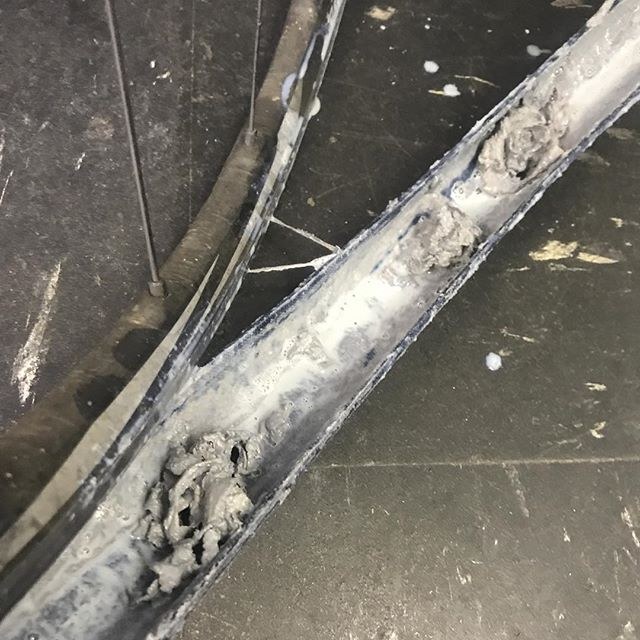
The manufacturer gives a useful warning: a Caffélatex-treated tire can remain airtight after the sealant has dried, but dry sealant no longer actively repairs punctures.[3] A tire that holds pressure overnight therefore still needs a liquid check. Do not rely on hearing a slosh as the only inspection.
Caffélatex bottles include a tube for valve injection, and the brand provides a tire-specific quantity table.[3] It is worth comparing if this installation method suits your wheels. Read the compatibility notes: Effetto Mariposa warns that the sealant’s water content can oxidize unprotected aluminum rim surfaces.[3] Proper rim preparation still matters.
View Caffélatex details Check the exact version and size before buying.
SILCA Ultimate Tubeless Tire Sealant: valve injection without a separate replenisher
The version to compare here is the current SILCA Ultimate Tubeless Tire Sealant: the injectable blend of natural and synthetic latex, not the older Ultimate Tubeless Sealant w/FIBERFOAM. SILCA describes the current formula as a one-step system; it can be injected through compatible valves, and the injector is sold separately.[4]
For maintenance, SILCA says to reinstall the current sealant every six months and top it up with the same product if sealant is lost through a puncture. It does not require a separate replenisher.[4] Treat that schedule as manufacturer guidance, not six months of guaranteed protection in a hot, dry tire. Keep checking that liquid remains, especially before a long ride or after storage.
Check the valve before buying: SILCA excludes Reserve Fillmore valves from compatibility. Do not mix this formula with SILCA’s older sealant or its replenisher. The brand also asks riders switching from another sealant to remove the old liquid and dried residue first. Use the current product’s tire-size dosing chart; SILCA suggests considering an extra ounce for an initial installation in a new tire.[4]
The distinction matters if you already have a bottle of the older w/FIBERFOAM product. Its product-specific instructions require pouring it directly into the tire, not injecting it through a valve, and call for a separate replenisher every 90–120 days.[5] Those are not the instructions for the current injectable formula. Match the instructions to the bottle rather than treating every SILCA sealant as interchangeable.
SILCA prefers a hand or floor pump for the current formula. If you use CO2 to get home, its guidance is to deflate and reinflate with a hand or floor pump afterward; an air compressor should be properly drained to avoid contamination.[4] This is a useful shortlist option if you want valve-access top-ups without managing a second maintenance fluid, provided your valves and tire setup are compatible.
View current SILCA Ultimate Tubeless Tire Sealant details · Check price at Jenson USA
How much sealant to use, and when to check it
Use the instructions for the exact formula and tire size rather than a universal “road” or “MTB” amount. For example, Stan’s lists 60 ml for a 700c × 40 mm tire and 110 ml for a 29 × 2.4-inch tire; Effetto Mariposa gives 60 ml as its example for a 29 × 2.10 tubeless tire.[1][3] These are different products and tire sizes, not interchangeable recipes.
- Write down the formula, amount and installation date. Set the first inspection from the manufacturer’s instructions and shorten the interval if your checks show rapid loss of liquid.
- Before a long or remote ride, inspect the tire for damage, confirm pressure and check that active liquid remains using the method permitted for your formula.
- Shake and install the sealant according to its label. Check compatibility before mixing formulas, using CO2 or adding an insert. If compatibility is unclear, ask the manufacturers instead of assuming.
- Keep a repair plan: a pump, compatible plugs and a spare tube or other backup suitable for your wheel setup. A sealant claim is not a guarantee that you can ride out on a cut casing.
What sealant cannot fix
Treat repeated pressure loss as a problem to diagnose, not an instruction to keep pouring in liquid. Inspect the tire, tape and valve, and stop riding if the tire will not hold safe pressure. Follow the tire and rim makers’ compatibility and pressure limits; sealant does not make an incompatible wheel-and-tire combination suitable for tubeless use.
For a dry-climate shortlist, compare Endurance if reducing top-off work is the goal, Race Day if frequent event preparation is already part of your routine, and Caffélatex if its synthetic formula and injection method fit your setup. Add the current SILCA Ultimate Tubeless Tire Sealant if you want valve injection and same-product top-ups, after checking valve compatibility.[4] Whichever you choose, confirm liquid before a ride where a flat would leave you a long walk from help.
Sources
- [1] https://stans.com/products/stans-race-day-tubeless-sealant — Stan’s Race Day Tubeless Sealant
- [2] https://orangeseal.com/products/endurance-sealant-w-inj-system — Orange Seal Endurance
- [3] https://www.effettomariposa.eu/en-us/products/caffelatex-bicycle-tyre-sealant — Effetto Mariposa Caffélatex
- [4] https://silca.cc/products/ultimate-tubeless-sealant — SILCA Ultimate Tubeless Tire Sealant (current injectable formula)
- [5] https://silca.cc/products/ultimate-tubeless-sealant-w-fiberfoam — SILCA older w/FIBERFOAM formula (product description and installation specifications)